Rotax break in, Rotax engine break in,
Rotax engine break in procedure.
|
|
|
|
|
|
|
|
|
|
|
Break in procedure for Rotax engines. |
|
Before you set about breaking in your new or rebuilt
engine you should first have it set up correctly, and the engine loaded
properly.
Click
here for more information!
All new and rebuilt Rotax aircraft engines should be put through
the standard Rotax break in procedure, to ensure proper seating of rings, cylinders,
pistons etc. This break in requires that you have an accurate tachometer, and engine heat
gauges, including exhaust gas temperature gauges for each cylinder, and a water temp gauge
for liquid cooled engines.
Click here for more
information
Where it is not possible to supply enough air flow to the
radiator to maintain a constant temperature (such as in the case of a Rans S12) it is
recommended that a garden hose be used to run a flow of water over the rad to keep
the temperature between 140 and 180 degrees F.
When breaking the engine use ear protection.
Always have an assistant to direct people, pets etc. away from the craft.
Maximum engine rpm for
277/337/447/503/532/582 is 6800 rpm
618 is 7,000 rpm
This limits are controlled by YOUR props
pitch - during break in set your prop up for these limits. Once finished
with the break in RESET your prop to give approximately 300 rpm less
than these values.
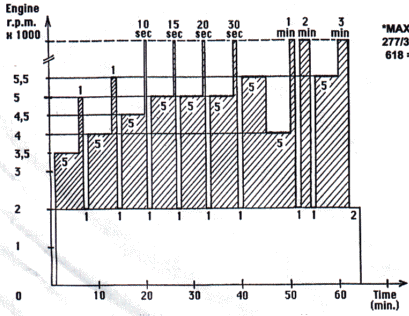
Rotax aircraft engine break in procedure.
|
|
All Rotax
2-cycle engines require break-in from the factory and when new pistons
and/or rings are installed to insure proper seating and cylinder/piston
wear. Be sure that the engine is properly installed on the aircraft and
has proper loading (propeller installed with correct pitch) to insure that
you do not exceed max recommended rpm*.
Static
testing (aircraft tied down properly) is recommended for break-in,
however, some free-air cowled installations required either taxiing,
flying or a hose with running water cooling the radiator in the case of a
liquid cooled engine.
Watch your
engine temperatures and if you must stop during break-in, begin at the
spot at which you stopped.
Cylinder heads on air-cooled engines must be re-torqued after break-in
when engine is COLD |
|
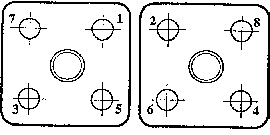
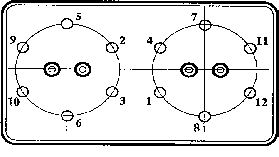
CYLINDER
HEAD TORQUING
Torque
cylinder head nuts following illustrated sequence when the intake/exhaust
manifolds are in place to ensure proper alignment.
ENGINE
MUST BE COLD FOR THIS PROCEDURE.
Use a
cross-sequence for tightening the nuts. Consider both cylinders as one
unit because they are joined by exhaust and intake manifolds. Torque spec
for cylinder head nuts (8mm) = 22NM/195 in lb. Requires 13mm socket.
The fan
belt tension on air cooled engines should also be checked.
Click here for more info. |
|
|
|
For hours and
hours of web video interviews on the world of ultralight
aviation subscribe to the Ultralight Flyer web video magazine -
Only $22.50 (approximately $15.00 U.S.) per year gives your access to web video on
ultralight aircraft, ultralight builders, ultralight
manufacturers, designer, accessories and much, much more!
|
|
|
|
Ultralight Aircraft News.ca Magazine
Resource Site
ulnews@ultralightnews.com
|
|
Ultralight Aircraft News.ca Web Magazine Resource Site .
No part of this
publication may be copied or distributed, transmitted, transcribed,
stored in a retrieval system, or translated into any human or computer
language, in any form or by any means, electronic, mechanical,
manual, or otherwise, without written permission .
By copying or paraphrasing the intellectual
property on this site, you're automatically signing a binding contract
and agreeing to be billed $10,000 payable immediately. Copyright UltralightNews.ca .
|